Deconstructing Subset Construction
Reducing While Determinizing
April 16, 2026 @ TACAS
2 TU Dortmund University, Germany
NFA Canonization
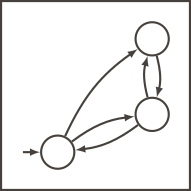
NFA
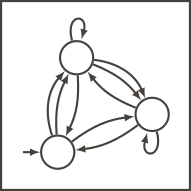

DFA
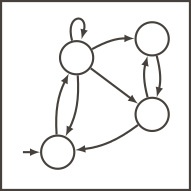

DFA'
Honorable Mentions
NFA analysis
- NFA universality testing (De Wulf et al., 2006)
- NFA language inclusion testing (Abdulla et al., 2010)
- NFA equivalence testing (Bonchi & Pous, 2013)
NFA canonization
- 2-phase reversal of NFAs (Brzozowski, 1962)
- External simulation information (Glabbeek & Ploeger, 2008)
On-The-Fly Minimization
NFA
DFA
DFA'

Subset Construction
A nondeterministic finite automaton (NFA) is a tuple $A = (S, \Sigma, \delta, S_0, F)$ such that
- $S$ denotes a finite non-empty set of states,
- $\Sigma$ denotes a finite non-empty set of input symbols,
- $\delta \subseteq S \times \Sigma \times S$ denotes the transition relation,
- $S_0 \subseteq S$ denotes the set of initial states, and
- $F \subseteq S$ denotes the set of final (or accepting) states.
A deterministic finite automaton (DFA) is an NFA $A' = (S', \Sigma, \delta', S_0', F')$ such that $\vert S'_0 \vert = 1$ and $\delta'$ is functional.
                            def determinize(nfa):

                                dfa = DFA()
                                dfa.S_0 = State(nfa.isAccepting(nfa.S_0))

                                mapping = {nfa.S_0: dfa.S_0}
                                queue = [nfa.S_0]

                                while len(queue) > 0:

                                    curr_nfa = queue.pop()
                                    curr_dfa = mapping[curr_nfa]

                                    for i in nfa.sigma:

                                        succ_nfa = nfa.delta[curr_nfa][i]
                                        succ_dfa = mapping[succ_nfa]

                                        if succ_dfa is None:
                                            succ_dfa = State(nfa.isAccepting(succ_nfa))
                                            mapping[succ_nfa] = succ_dfa
                                            queue.append(succ_nfa)

                                        dfa.delta[curr_dfa][i] = succ_dfa

                                return dfa
                            def determinize(nfa, reg):

                                dfa = DFA()
                                dfa.S_0 = State(nfa.isAccepting(nfa.S_0))

                                reg.put(nfa.S_0, dfa.S_0)
                                queue = [nfa.S_0]

                                while len(queue) > 0:

                                    curr_nfa = queue.pop()
                                    curr_dfa = reg.get(curr_nfa)

                                    for i in nfa.sigma:

                                        succ_nfa = nfa.delta[curr_nfa][i]
                                        succ_dfa = reg.get(succ_nfa)

                                        if succ_dfa is None:
                                            succ_dfa = State(nfa.isAccepting(succ_nfa))
                                            reg.put(succ_nfa, succ_dfa)
                                            queue.append(succ_nfa)

                                        dfa.delta[curr_dfa][i] = succ_dfa

                                return dfa
                            def determinize(nfa, reg, threshold):

                                dfa = DFA()
                                dfa.S_0 = State(nfa.isAccepting(nfa.S_0))

                                reg.put(nfa.S_0, dfa.S_0)
                                queue = [nfa.S_0]

                                while len(queue) > 0:

                                    curr_nfa = queue.pop()
                                    curr_dfa = reg.get(curr_nfa)

                                    for i in nfa.sigma:

                                        succ_nfa = nfa.delta[curr_nfa][i]
                                        succ_dfa = reg.get(succ_nfa)

                                        if succ_dfa is None:
                                            succ_dfa = State(nfa.isAccepting(succ_nfa))
                                            reg.put(succ_nfa, succ_dfa)
                                            queue.append(succ_nfa)

                                        dfa.delta[curr_dfa][i] = succ_dfa

                                    if threshold(dfa):
                                        equiv = minimize(dfa)
                                        for (s,t) in equiv:
                                            reg.unify(s,t)

                                return dfa
Equivalence Registries
A datastructure that supports the following operations:
- PUT($Q, q'$) links the language of metastate $Q$ to state $q'$.
- GET($Q$) returns a state $q' \in S'$ such that $L(Q) = L(q')$.
- UNIFY($q'_1, q'_2$) informs the registry about the equivalence of states $q'_1$ and $q'_2$.
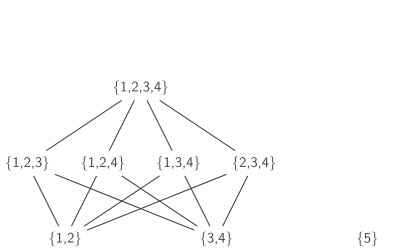
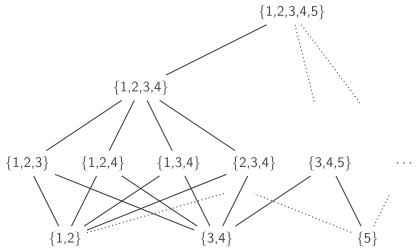
Convexity Closure Lattice (CCL)
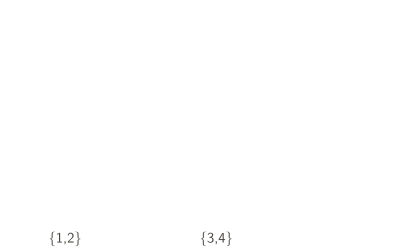
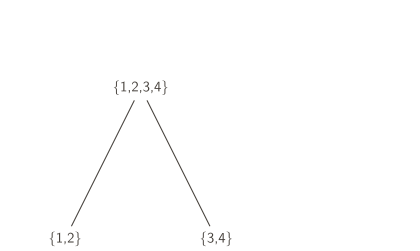
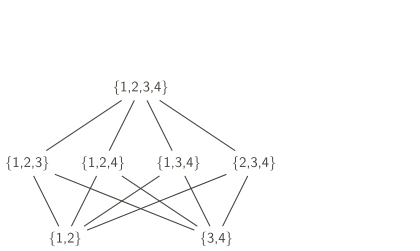
Central observation by Bonchi & Pous: Let $A, B \subseteq S$, then we have
$$L(A \cup B) = L(A) \cup L(B)$$
In case of $L(A) = L(B)$, we have
$$L(A \cup B) = L(A) \cup L(B) = L(A) = L(B)$$
Generalized to any $X$ with $A \subseteq X \subseteq A \cup B$, we have
$$L(A \cup B) = L(X) = L(A)$$
Convexity Closure Lattice (CCL)
CCL with simulation (CCLS)
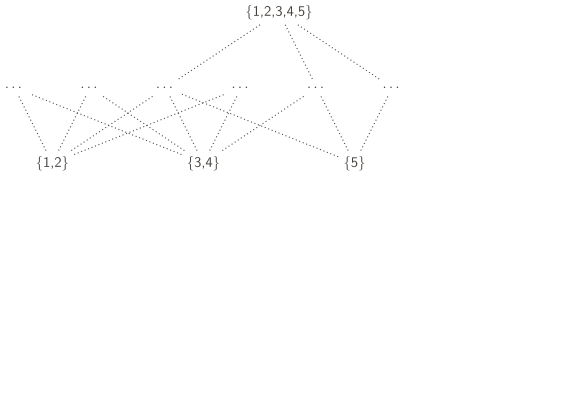
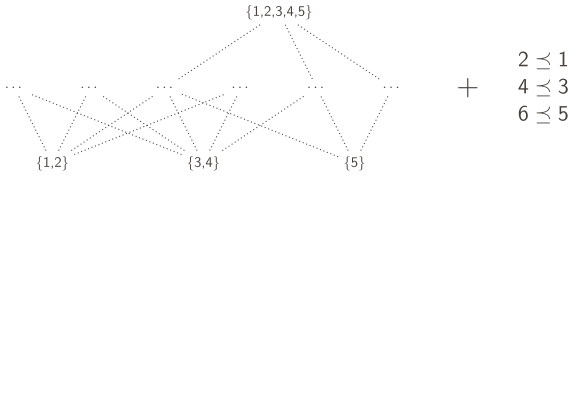
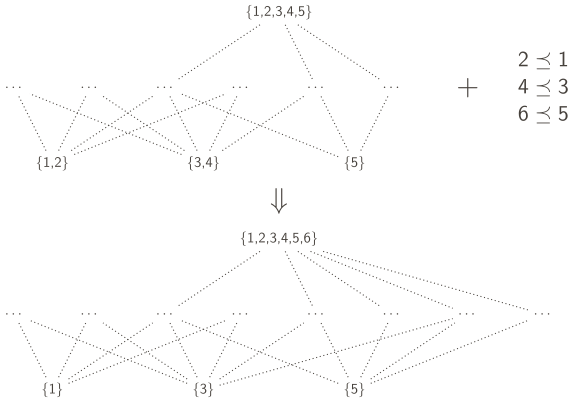
Let $a, b \in S$. If $b$ simulates $a$, i.e., $a \preceq b$, then
$$L(\{a\}) \subseteq L(\{b\})$$
Applied to our previous setting, this means
$$L(\{a,b\}) = L(\{a\}) \cup L(\{b\}) = L(\{b\})$$
Idea:
Prune (e.g., $\{a,b\} \mapsto \{b\}$) and saturate (e.g., $\{b\} \mapsto \{a,b\}$) $Q$ when invoking PUT($Q, q'$).
CCL with simulation (CCLS)
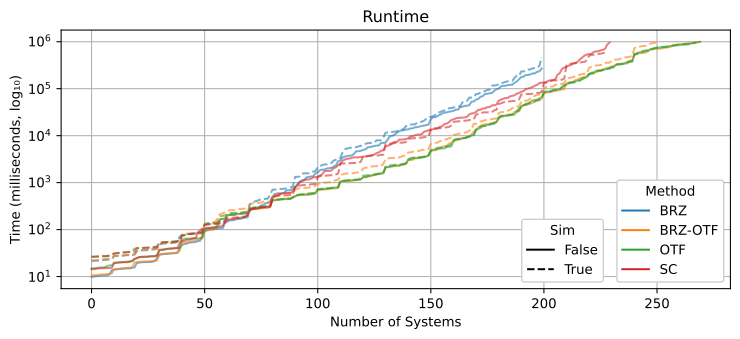
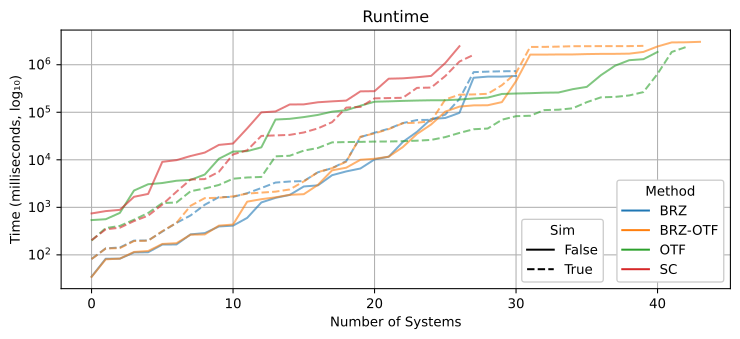
Benchmarks (Walnut)
Takeaways
- NFA canonization via on-the-fly minimization
- Parameterizable via equivalence registries and threshold predicates
- Open-source implementation available at

https://github.com/jn1z/OTF
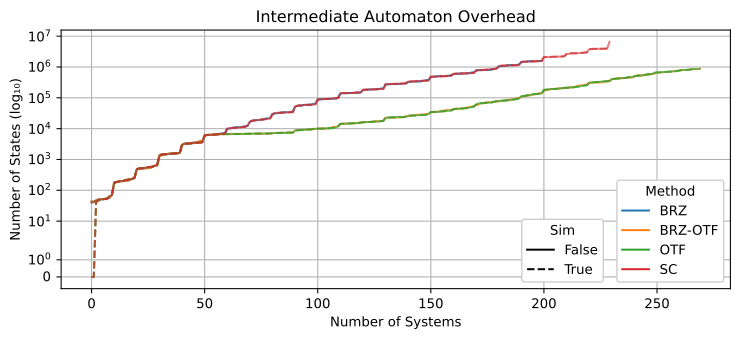
Bonus: Benchmarks (Walnut)
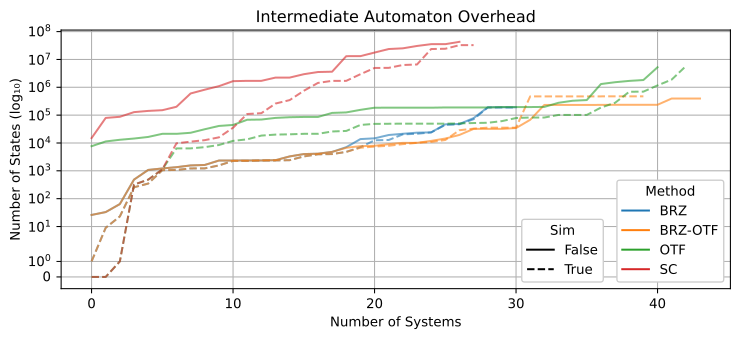
Bonus: Benchmarks (Ranmod)